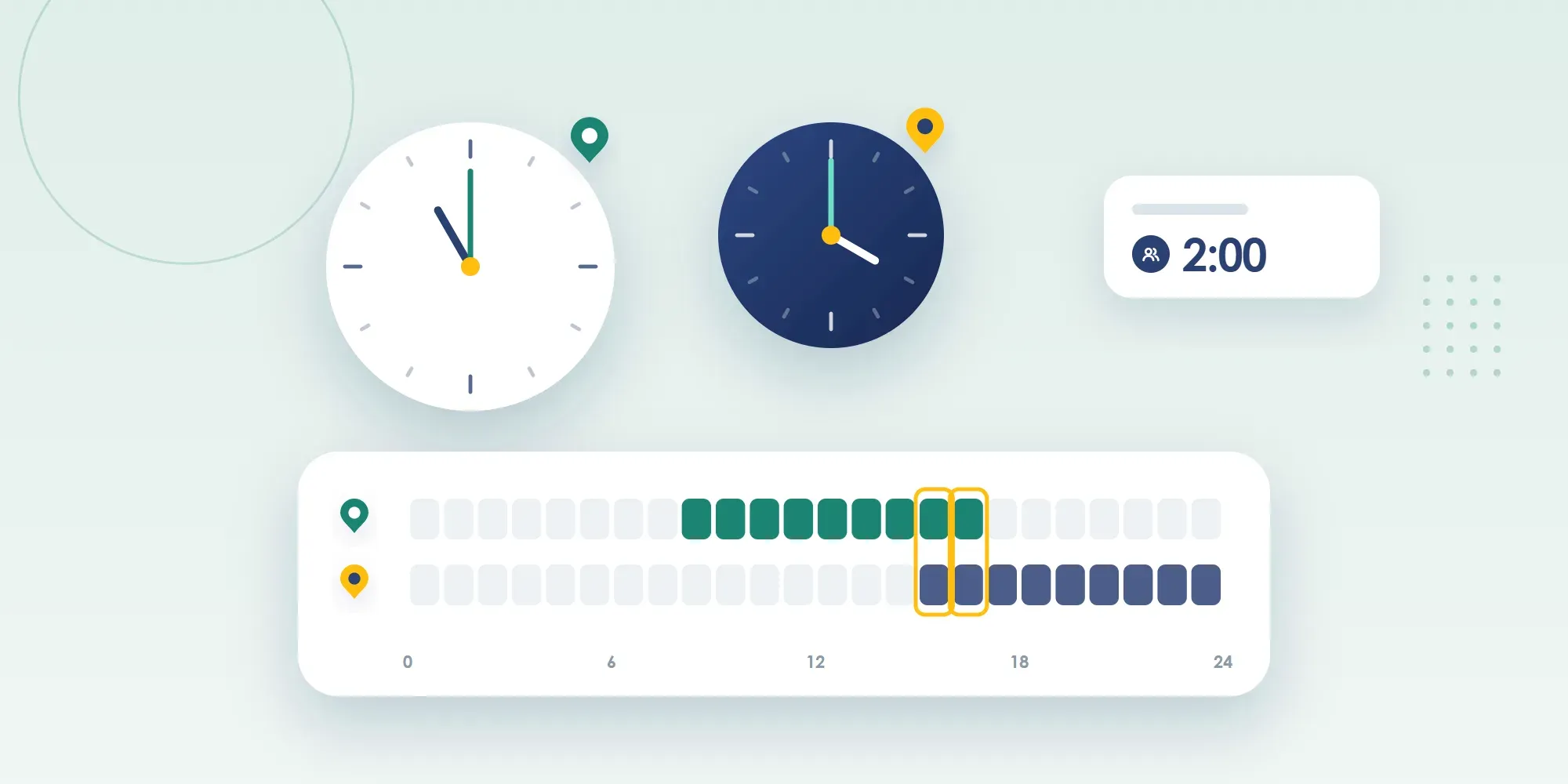
Cairo and New York share about three usable working hours a day. Cairo and San Francisco share barely one. Every argument about whether an offshore marketing team can really work is, underneath, an argument about what you do with those hours and what you are willing to stop doing outside them.
The actual arithmetic of an offshore marketing team
Cairo runs on UTC plus two all year with no daylight saving to complicate it. New York sits six hours behind Cairo through the American summer and seven hours behind through the winter. So four in the afternoon in Cairo is ten in the morning in New York in July and nine in January. A Cairo team finishing at six has handed a New York client a full working morning of overlap. Chicago costs another hour. Los Angeles is nine or ten hours behind, which leaves an overlap window of roughly sixty minutes unless the Cairo side works late or the California side starts early.
Write those numbers on the wall and stop negotiating them. The failure mode is pretending the gap is smaller than it is, then quietly resenting the nine o’clock calls until somebody resigns.
Asynchronous by default, meetings by exception
The single change that fixes most distributed teams is deciding that writing is the normal mode and a call is the escalation. It sounds obvious and almost nobody does it, because a quick call feels efficient to the person placing it and costs the person receiving it their next three hours of concentration.
In practice that means every request carries enough context to be acted on without a follow up question. Every piece of work ships with a short written note saying what was done, what was assumed and what is blocked. Decisions land somewhere durable rather than in a thread that scrolls away by Thursday. And there is one recurring overlap meeting a week that everybody protects, instead of five that everybody half attends.
Handover discipline matters more than any tool you buy. A Cairo team that ends the day with a clean written handoff gives an American client finished work waiting at breakfast. A team that ends the day with open questions has just cost the project twenty four hours, and it will do it again tomorrow.
Judge output, not attendance
This year has settled the question of whether distributed work is possible, because most of the world ran the experiment at once and the sky did not fall. What it has not settled is management. Plenty of companies went remote and simply moved supervision online: status pings, cameras on, availability treated as a proxy for effort.
With a real time zone gap that approach collapses within a month. If you cannot watch people, the only workable contract is a clear definition of done, an agreed cadence and an honest review of the work itself. Set a weekly deliverable, review it properly, and stop counting hours. Most teams that make the switch find the offshore relationship gets easier and the in house one improves as a side effect.
Protect one shared ritual
Distributed teams rarely fail on process. They fail on trust, and trust is built in the parts of a conversation that have nothing to do with the task. Keep one weekly call inside the overlap window that is allowed to run five minutes long, put cameras on for that one, and make sure the people doing the work are in the room rather than only the account manager. It is the cheapest insurance you will buy all year, and it is the first thing that gets cut when a quarter goes badly.
If you want to see who would actually be on your account, our team page introduces the people, and you can always talk to us directly about how we would set up that overlap for you before committing to anything.